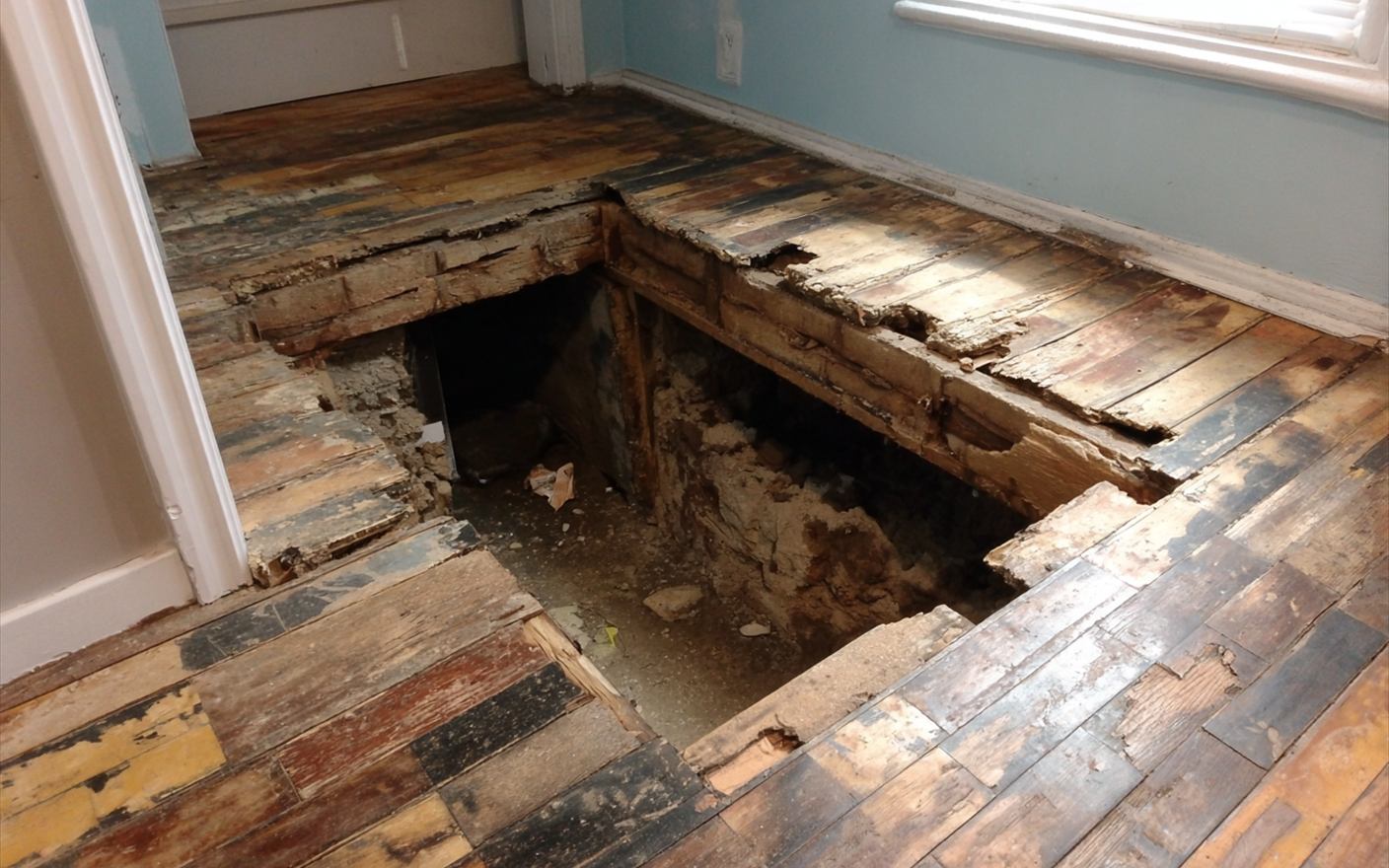
Floor Water Damage in Kent Homes
Usual size: one room's floor, sometimes running under a wall into the next one.
What can be saved depends on the floor, the subfloor and how long the water sat. A floor is a stack: the finish you walk on, an underlayment or pad, and a subfloor of plywood, OSB or particleboard on the joists. Water gets into each layer differently, and each one dries at its own speed. For wood floor water damage repair and drying in Kent, call (253) 322-1508.
By Material
| Floor | What water does to it | Can it usually be dried in place? |
|---|---|---|
| Solid hardwood | Boards swell across their width and cup, edges higher than centers | Often, if caught early and dried slowly; badly cupped or buckled boards are replaced |
| Engineered wood | The thin wood layer can separate from its plywood core | Sometimes; a lifted or delaminated top layer can't be saved |
| Laminate | The fiberboard core swells at the seams and doesn't shrink back | Rarely; swollen planks are replaced |
| Vinyl plank | The plank itself shrugs off water, but water traps underneath it | The planks often survive; the subfloor under them is the concern |
| Carpet | Carpet may dry; pad holds water and is usually replaced | Carpet often, pad rarely |
| Tile | Tile is fine; water gets under it through grout and cracks | The tile usually stays; the subfloor or slab below is measured |
The Subfloor Underneath
The subfloor decides whether a floor can be dried or has to come up. In Kent houses, subfloors over a crawlspace or a lower level are usually plywood or OSB, and some older homes have particleboard under carpet or vinyl. Plywood tolerates a short wetting. OSB swells at its edges. Particleboard swells and crumbles and usually can't be saved. A soft spot underfoot, especially around a toilet or tub, is often subfloor damage that's been going on for a while. More: subfloors after a leak.
Saving a Floor or Replacing It
Drying hardwood is slow on purpose. A company may lay drying mats on the boards that pull moisture up through the wood, or run air under the floor from the crawlspace or ceiling below. Drying too fast makes boards crack. Many cupped boards flatten as they dry over a week or two, then get sanded and refinished. Boards that have crowned or buckled off the subfloor are replaced.
Laminate and swollen particleboard almost always come out. Once their fiber cores swell, they don't recover. Taking them out quickly also lets the subfloor below dry.
Carpet is a judgment call. Clean water caught early usually means the carpet stays and the pad is replaced. Water that sat for days or came from a dirty source changes that.
Kitchens and Bathrooms
Most floor damage in Kent homes starts in the two rooms with the most plumbing. In kitchens, a dishwasher hose, a fridge water line or a sink drain leaks under the cabinets, and water runs under the toe-kick and across the floor. In bathrooms, a toilet seal or tub drain leaks slowly into the subfloor for months. See kitchen leaks and bathroom leaks you don't see.
Vinyl Plank: Fine on Top, Wet Underneath
Vinyl plank is the most common new floor in Kent remodels, and it hides water better than anything else. The planks themselves are waterproof, so the surface looks fine after a leak. But the planks click together and float over the subfloor, often on a thin underlayment, and water that gets under them has nowhere to go. It sits against the subfloor for days or weeks. Signs are subtle: a plank that shifts, a seam that rises slightly, a musty smell near the floor. A restoration company measures through the planks or lifts a row at the edge to check what's underneath. Planks can often be taken up, set aside and reinstalled once the subfloor is dry.
Floors Over Garages and Lower Levels
In Kent's split-levels, some floors sit over a garage or a lower family room, and that's the easiest place to see a leak from below. Water through a bedroom or bathroom floor in a split-level often shows up as a stain on the garage ceiling or the lower-level ceiling first. That's useful: opening the ceiling below lets the subfloor dry from underneath without lifting a finished floor above. On a slab floor in a lower level, there's no below to work from, so the finish floor usually has to come up for the slab to dry.
Furniture, Rugs and Heat Registers
- Furniture legs on a wet floor leave rust or stain marks and wick water up; set them on blocks or foil until the floor is dry.
- Area rugs trap water against hardwood and should be lifted right away; dyes can bleed into a light floor.
- Floor heat registers in older houses can let water drop into a duct; mention it if water reached one.
- Baseboards often have to come off so air can reach the gap where the floor meets the wall.
Will Cupped Hardwood Flatten on Its Own?
Some will, once the subfloor and the boards are dried slowly. Sanding cupped boards before they're dry leaves them crowned later. A company measures moisture in the boards and the subfloor before deciding.
Why Is the Floor Soft but Dry on Top?
The surface can dry while the subfloor underneath stays wet or has started to break down. A soft spot near a toilet, tub or dishwasher is a sign the leak has been going for a while. It needs to be opened and checked.
Floor Jobs Across Kent
The Valley floor
West Hill
East Hill
- East Hill NorthEast Hill
- East Hill SouthEast Hill
- Panther LakeEast Hill
- Lake MeridianEast Hill
- MeridianEast Hill
- KentridgeEast Hill
Beyond Kent
- Des MoinesBeyond Kent
- Normandy ParkBeyond Kent
- Lakeland NorthBeyond Kent
- Lakeland SouthBeyond Kent
- Lake Morton-BerrydaleBeyond Kent
- RavensdaleBeyond Kent
- HobartBeyond Kent
When the water was more than one floor: water extraction and cleanup.