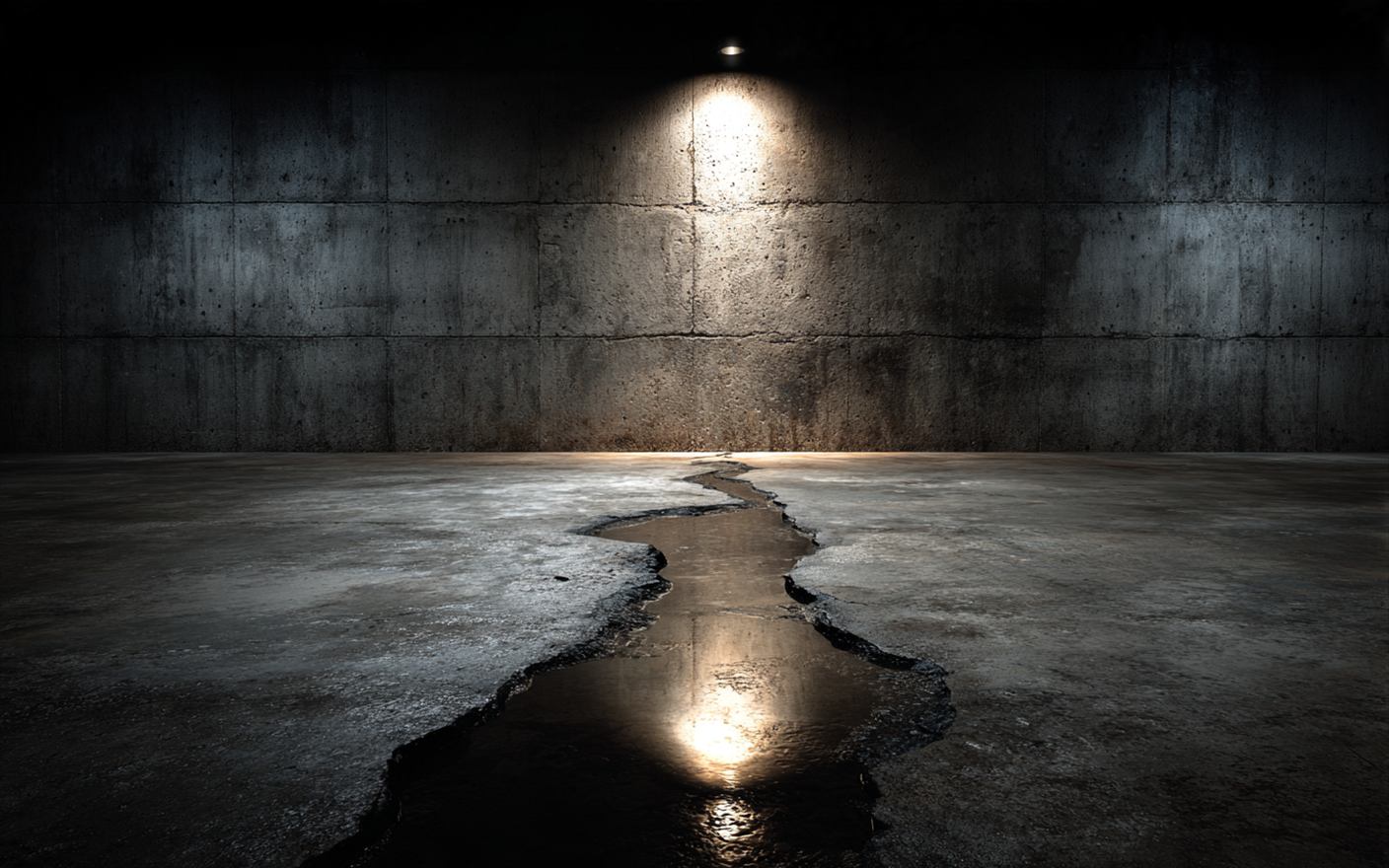
Usual size: a thin line of water along the base of one wall, spreading a few inches to a few feet across the floor, worst after weeks of rain. The cove joint is the seam between a foundation wall and the concrete floor slab. They're poured separately, so the seam is a natural gap. When the soil outside is saturated, water pressure pushes moisture through it. In Kent, it's one of the most common ways lower levels on both hills get wet.
Why It Happens Here
Concrete walls and floors are poured at different times, and the floor slab is usually set inside the walls after they've cured. Where they meet, there's a cold joint, not a solid bond. Most of the year, it's dry. But when the ground around the foundation fills with water, which happens in the Puget Sound lowlands after the long run of fall and winter rain, the water presses against the wall and finds the joint.
Kent's split-levels and sloped-lot houses on West Hill and East Hill often have one lower-level wall fully against the hillside. That wall gets the most pressure. A wet line along it, and dry floors everywhere else, is the classic sign.
What It Looks Like
- A thin, dark line along the bottom of the wall, sometimes with a white crusty residue from minerals left as water evaporates
- Water spreading across the slab from the wall, often after a few days of heavy rain
- Carpet wet along one wall in a finished lower level, dry in the middle of the room
- Baseboard swelling or paint bubbling at the bottom of drywall on a foundation wall
- A damp, earthy smell in a finished room after storms
Seepage or a Leak?
Water at the base of a wall can also come from inside: a supply line in the wall, a water heater, a washer drain. A few clues:
| Clue | Points to |
|---|---|
| Shows up only after long rains, fades in dry weather | Seepage at the cove joint |
| Along the wall that faces uphill or a lake | Seepage |
| Shows up any time, rain or not | A plumbing leak |
| Wettest near a fixture, an appliance or the water heater | A plumbing leak |
| Water is warm | A hot water line or the water heater |
A restoration company confirms it with a meter, often by checking how high up the wall the moisture reaches and where it's wettest.
Drying After Seepage
In an unfinished basement, drying is straightforward: remove standing water, run dehumidifiers, and let the slab and wall dry. In a finished lower level, the company usually pulls wet pad and carpet back, opens the bottom of the drywall on the wet wall to dry the cavity, and checks for insulation or framing that held water. Drying won't stop the next round of seepage; that needs drainage or waterproofing work outside or inside the wall, which is separate from the restoration.
What Helps Outside
Many seepage problems get worse because of what happens at the surface: gutters that overflow next to the wall, downspouts that empty against the foundation, soil sloping toward the house. Those are outside fixes, but they're worth knowing about, because they're often the cheapest part of the answer.
When It Usually Starts
Seepage at the cove joint follows the rain calendar more than the calendar on the wall. The first storms of fall usually soak into dry ground without trouble. By late fall and winter, after weeks of steady rain, the soil around a foundation is saturated and stays that way, and that's when the wet line appears. A heavy atmospheric river can bring it on quickly. Seepage often fades in spring and disappears in summer, which is why it can be easy to forget about until the next winter.
Finished Lower Levels Hide It
In a finished split-level family room, the cove joint is behind the baseboard and under the carpet. The first sign is often carpet that's damp along one wall, or a smell after a rainy week. By then, the pad and the bottom of the drywall have been taking on water for a while. That's the size the job usually is by the time anyone calls: one wall's length of pad, baseboard and lower drywall.
Questions
Does the white residue mean something is wrong with the concrete?
It's usually efflorescence, salts left behind as water moves through concrete and evaporates. It's a sign water is getting through, not of the concrete failing.
Will sealing the joint from inside stop it?
Sometimes for a while. Water under pressure often finds another path. Long-term fixes are a question for a waterproofing contractor.
Is it worth drying if it'll happen again?
Yes. Wet carpet, pad and drywall left in place get worse every time, and drying now limits the damage while drainage is sorted out.
Around Kent
Cove joint seepage shows up in lower levels across West Hill North, in split-levels in East Hill South, and in older houses on Scenic Hill. The service page is flooded basements and lower levels.
Ready.gov: floods and water getting into homes

Lake Meridian, Panther Lake and Lake Fenwick: Living on a Lakeside Lot
High water tables and the lowest floor.
Subfloors: What's Under the Floor After a Leak
Plywood, OSB, particleboard and what survives.